

May 2026Glocomms, with insight from Alissa Kapp13 min read
What is a Forward Deployed Engineer?

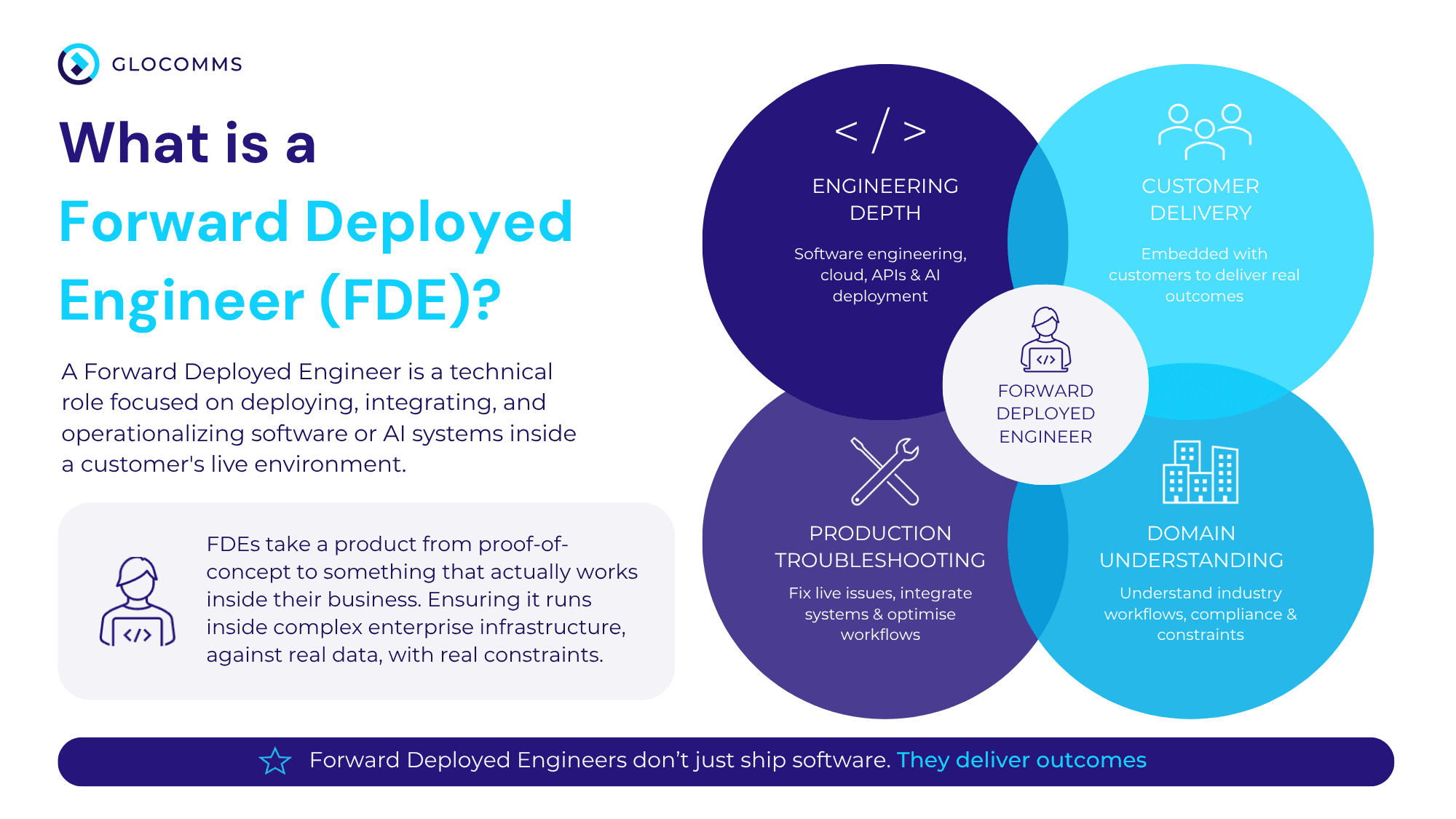
A Forward Deployed Engineer is a technical role focused on deploying, integrating, and operationalizing software or AI systems inside a customer's live environment. Forward Deployed Engineers (FDEs) have quickly become one of the most talked-about roles in enterprise technology hiring. Job postings grew from 643 in April 2025 to 5,330 by April 2026 according to Indeed, and the hiring appetite spans the full width of the industry. Anthropic, OpenAI, Palantir, Salesforce, Google Cloud, and Stripe are all actively building FDE teams.
At Glocomms, we've been placing specialist technology talent for over a decade, and few roles have gathered this much hiring momentum this quickly.
The role, pioneered by Palantir, sits at the intersection of software engineering, technical consulting, and customer delivery. Forward Deployed Engineers work directly with customers to deploy, customize, integrate, and optimize software or AI systems in live environments. They're the people who take a product that functions in a demo and get it running in the real world, inside complex enterprise infrastructure, against real data, with real constraints.
What began as one company's approach to enterprise delivery has quietly become one of the most sought-after roles in modern technology hiring.
This article includes hiring market insight from Alissa Kapp, Principal Consultant at Glocomms USA, specializing in Forward Deployed Engineering and AI talent recruitment.
Where the FDE model came from
Palantir built the FDE model out of necessity.
Their core product was data integration and intelligence software, built initially for defense and intelligence agencies. Technically sophisticated, operationally complex, and deployed inside some of the most restricted infrastructure in existence.
The problem
The standard delivery approach did not work. Closing a contract and handing implementation to a separate services function left too large a gap between what the software could do and what a customer could actually get running. In environments where a failed deployment carried direct operational consequences, that gap was not acceptable.
The solution
Palantir embedded engineers directly inside customer environments for the duration of a deployment. Not consultants producing reports and moving on. Engineers who stayed until the system worked, who knew the product well enough to adapt it to constraints that only became visible once they were inside the infrastructure, and who could operate across both the technical and organizational complexity of a live enterprise environment.
The outcome
Better deployments, faster adoption, longer customer relationships. And something less expected: a type of engineer the market had no existing name for. Someone with software engineering depth, the client-facing range of a delivery consultant, and the practical judgment that only comes from working in live production environments.
For years this remained Palantir's approach, applied across defense, intelligence, financial services, and healthcare. The broader market watched but did not replicate it at scale. Most products did not require that depth of embedded delivery, and the organizational appetite to resource deployments that way was not there.
What changed is the nature of enterprise AI. Deploying large language models, data pipelines, and AI workflows into live business environments has created the same conditions that originally produced the FDE model: fragmented infrastructure, high failure risk, and a gap too large for conventional implementation approaches to close. The Forward Deployed Engineer went from a Palantir-specific answer to a problem the whole industry now shares.
What does a Forward Deployed Engineer role involve?
In practice, the role is about helping customers take a product from proof of concept to something that actually works inside their business. That sounds straightforward, but in a complex enterprise environment it rarely is.
The split between engineering work and customer-facing responsibilities varies hugely depending on the company, the product, and where a deployment sits in its lifecycle.
Day-to-day responsibilities for an FDE typically include:
- Deploying software or AI systems into production environments
- Integrating platforms with customer infrastructure and APIs
- Troubleshooting implementation issues in live environments
- Understanding and translating customer technical requirements
- Customizing workflows and deployment configurations
- Collaborating with internal engineering and product teams
- Supporting customers in scaling deployments over time
Much of the work is highly practical. FDEs are regularly dealing with broken integrations, infrastructure constraints, deployment bottlenecks, and the challenge of adapting a product to fit workflows it was never specifically designed for.
It's also one of the few technical roles that demands deep engineering capability alongside strong customer communication. An FDE might spend part of the day debugging deployment issues with an internal engineering team, then switch into a customer meeting to explain implementation trade-offs to non-technical stakeholders.
That mix of technical depth and commercial awareness is a big part of why the role has become so valuable.
Why are Forward Deployed Engineers in demand?
The short answer is that enterprise AI adoption has created a problem most companies weren't prepared for.
Buying or building capable AI is one challenge. Making it work inside a real business, with all the legacy infrastructure, compliance requirements, and organizational complexity that entails, is another one entirely.
The hardest positions we're filling combine strong engineering backgrounds with experience delivering inside client environments. That profile is rare, and the market has priced it accordingly.
That pattern is showing up at scale. Enterprises invested $684 billion in AI in 2025 alone, but for many companies that investment is quietly eroding rather than compounding.
The data reflects the scale of the problem:
60%
of organizations generate no material value from AI despite continued investment (BCG, 2025)
Only 28%
of AI use cases fully meet ROI expectations (Gartner, April 2026)
Sources: BCG The Widening AI Value Gap, 2025 | Gartner Survey, April 2026
That gap between what AI can do and what organizations can successfully deploy is the structural reason demand for Forward Deployed Engineers has grown so sharply.
AI is 20% algorithms and 80% organizational rewiring.
Most AI projects don't fail because the model stops working. They fail when deployment collides with the reality of enterprise infrastructure.
That usually means:
- Fragmented internal systems
- Disconnected data environments
- Security reviews
- Compliance requirements
- Procurement processes
- Competing internal stakeholders
- Unclear ownership once deployment begins
This is the gap Forward Deployed Engineers exist to close.
From experimentation to execution
For several years, the dominant question in enterprise technology was whether AI could do anything useful. That question has largely been answered. The new question is whether organizations can actually absorb the technology at scale, and most are finding the answer far more difficult than expected.
The shift exposed something that wasn't obvious during the experimentation phase. Internal engineering teams built to develop and maintain software are not the same as teams capable of deploying complex AI systems into live environments.
These are different skills, different pressures, and different failure modes. As deployment volume has grown, that gap has become more visible inside organizations that assumed their existing teams could handle it.
Deployment speed has become a commercial priority
Boards that approved significant AI budgets in 2024 and 2025 are now asking direct questions about what those investments have produced. For many organizations, the returns have not matched expectations, and that scrutiny is changing how implementation is prioritized internally.
The organizations pulling ahead are the ones treating deployment as a discipline in its own right, not an afterthought to procurement. Where AI adoption was previously measured by the number of initiatives launched, it is now measured by the number that actually reached production and delivered something. This is driving demand for people who can close the distance between a working product and a working deployment.
In April 2026, EY formally launched Forward Deployed Engineer roles in the UK and Ireland. Deloitte, Accenture, PwC, KPMG, and the tier-two systems integrators are expected to follow within twelve months. When the Big Four start building dedicated capability around a delivery model, it signals that the problem is structural, not transitional.
The demand for hybrid technical talent
The FDE profile is unusual because the role draws on skills that don't typically sit in the same person. Software engineering depth, direct customer communication, commercial awareness, and the practical judgment that comes from working in live production environments rather than controlled development cycles. Individually, those qualities are findable. Together, in someone who also understands modern AI systems, they are rare enough that the market has priced accordingly.
Forward Deployed Engineer salary data puts base salaries at $170,000 to $200,000 USD. In the roles we've recently worked on, compensation has tended to sit toward the upper end of that range, particularly for hires with both cloud and customer-facing delivery experience.
What skills do Forward Deployed Engineers need?
The FDE role sits across engineering, implementation, and customer delivery, which means Forward Deployed Engineer skills are broader than most purely technical roles. The exact technical mix varies depending on the product and environment, but the combination of deep engineering capability and strong client-facing skills is consistent across every FDE hire we see.
For candidates looking to build these skills into a career move, our guide on how to become a Forward Deployed Engineer explains which backgrounds transition well into FDE roles, how to position relevant experience, and what hiring teams are looking for.
Forward Deployed Engineer vs. Solutions Engineer
Solutions Engineers and FDEs are not the same role. A Solutions Engineer works pre-sale, helping prospects understand what a product can do and whether it fits their needs. An FDE comes in after the contract is signed and makes it work inside the client's actual environment. The mandate is different, the relationships are different, and so are the failure modes.
In simple terms, Solutions Engineers help sell the product, while Forward Deployed Engineers make it work in practice.
Which industries are hiring Forward Deployed Engineers?
Demand for Forward Deployed Engineers is not concentrated in a single sector. The common thread is enterprise complexity: large-scale infrastructure, regulated data, and environments where a failed deployment has real consequences.
Financial Services
Banks, insurers, and capital markets firms run some of the most tightly regulated infrastructure in enterprise technology. FDEs in this sector spend significant time navigating data sovereignty requirements, security reviews, and legacy system integration. A failed deployment here carries direct compliance risk, not just operational inconvenience.
Healthcare
Healthcare deployments sit at the intersection of clinical workflow complexity and strict data governance. FDEs are typically working across fragmented systems, including electronic health records, diagnostic platforms, and claims infrastructure, where integration requires both technical depth and a working understanding of how clinical teams actually operate day to day.
Defense and Government
Cleared environments add constraints most commercial deployments do not face. FDEs working in defense and government need to understand air-gapped infrastructure, security classification requirements, and procurement timelines that operate very differently from the private sector.
Professional Services
Consultancies and law firms are deploying AI across knowledge work, including document review, due diligence, and client reporting. The integration challenge here is less about legacy infrastructure and more about workflow adoption. Getting highly skilled professionals to change how they work requires FDEs to operate effectively at the human layer as well as the technical one.
Energy and Utilities
Operational technology environments in energy and utilities are often decades old and were never designed to integrate with modern software systems. FDEs in this sector are frequently bridging the gap between OT and IT infrastructure, which requires both industrial domain awareness and cloud engineering capability.
Retail and eCommerce
Scale and speed define the deployment challenge in retail. FDEs are typically integrating AI across demand forecasting, inventory management, and customer experience systems, where deployment failures have immediate commercial consequences, particularly during peak trading periods.
Telecommunications
Telecom infrastructure is vast, distributed, and built on layered legacy systems. AI deployments here typically target network optimization, churn prediction, and customer service automation, all of which require FDEs to work across technical estates that span decades of technology investment.
Logistics and Supply Chain
Real-time data dependency makes logistics one of the more technically demanding FDE environments. Deployments connect AI systems to warehouse management, routing engines, and supplier networks, where the work has to function under operational pressure with very limited tolerance for downtime.
Legal and Compliance
Legal tech deployments are accelerating as firms look to automate document-heavy workflows. FDEs in this space navigate both technical integration and high stakeholder sensitivity. Legal and compliance teams are exacting about how systems handle privileged or regulated information.
Media and Technology
Technology companies deploying AI internally or embedding it into products need FDEs who can operate at the product layer as well as the infrastructure layer. The deployment challenge is often less about legacy constraints and more about scale, latency, and continuous iteration in live environments.
Why Forward Deployed Engineers matter in AI
The way most organizations think about AI investment is still skewed toward acquisition. Which model, which platform, which vendor. Those are real decisions, but they are not where most AI programs succeed or fail.
What's shifted is accountability. For years, the burden of a failed deployment sat with the business that commissioned it. Wrong use case, insufficient data, poor change management. That framing is giving way to a more honest one. The organizations pulling ahead are treating successful deployment as an engineering discipline and resourcing it accordingly.
Forward Deployed Engineers are the people organizations are hiring to close that gap. Engineers with enough technical depth to own a deployment and enough range to navigate the organizational complexity around it.
The future of Forward Deployed Engineering
Palantir spent a decade proving that embedding engineers inside complex organizations produces better outcomes than any amount of advisory work. What began as one company's operating model is now becoming standard practice in enterprise AI delivery.
The companies scaling FDE functions today, from frontier AI labs to the Big Four consultancies, are making a structural bet on how enterprise technology gets delivered from here.
That shift reflects a change in where value is actually created. Not when a product is bought, or even when it is built, but when it is made to work inside a real environment. The gap between what can be built and what organizations can successfully run has not closed. Until it does, demand for Forward Deployed Engineers will keep growing. The companies treating deployment as an engineering discipline are already starting to pull ahead.
Sources
- EY, EY launches Forward Deployed Engineer roles to scale AI into production, April 2026
- Boston Consulting Group, The Widening AI Value Gap, 2025
- Gartner, AI ROI Survey, April 2026
- McKinsey & Company, The State of AI 2025, November 2025
- Indeed, Forward Deployed Engineer job postings and salary data, 2025–2026
Alissa Kapp
Principal Consultant at Glocomms, based in North America
Alissa Kapp is a recruitment consultant specializing in sales, marketing, product management, and Forward Deployed Engineering roles within the emerging technology space. At Glocomms, she works with organizations ranging from global enterprise leaders to high-growth startups across AI, software development, cybersecurity, and commercial technology functions.
Alissa contributed hiring market insight and compensation perspective to this article based on her experience supporting Forward Deployed Engineer searches within the AI technology market.

Request talent
Request a call back and one of our experienced consultants will get in touch to discuss your hiring requirements.
Advancing your career
Want to be one step ahead in your career? Our industry experts have the relationships and global reach to realize your full potential.